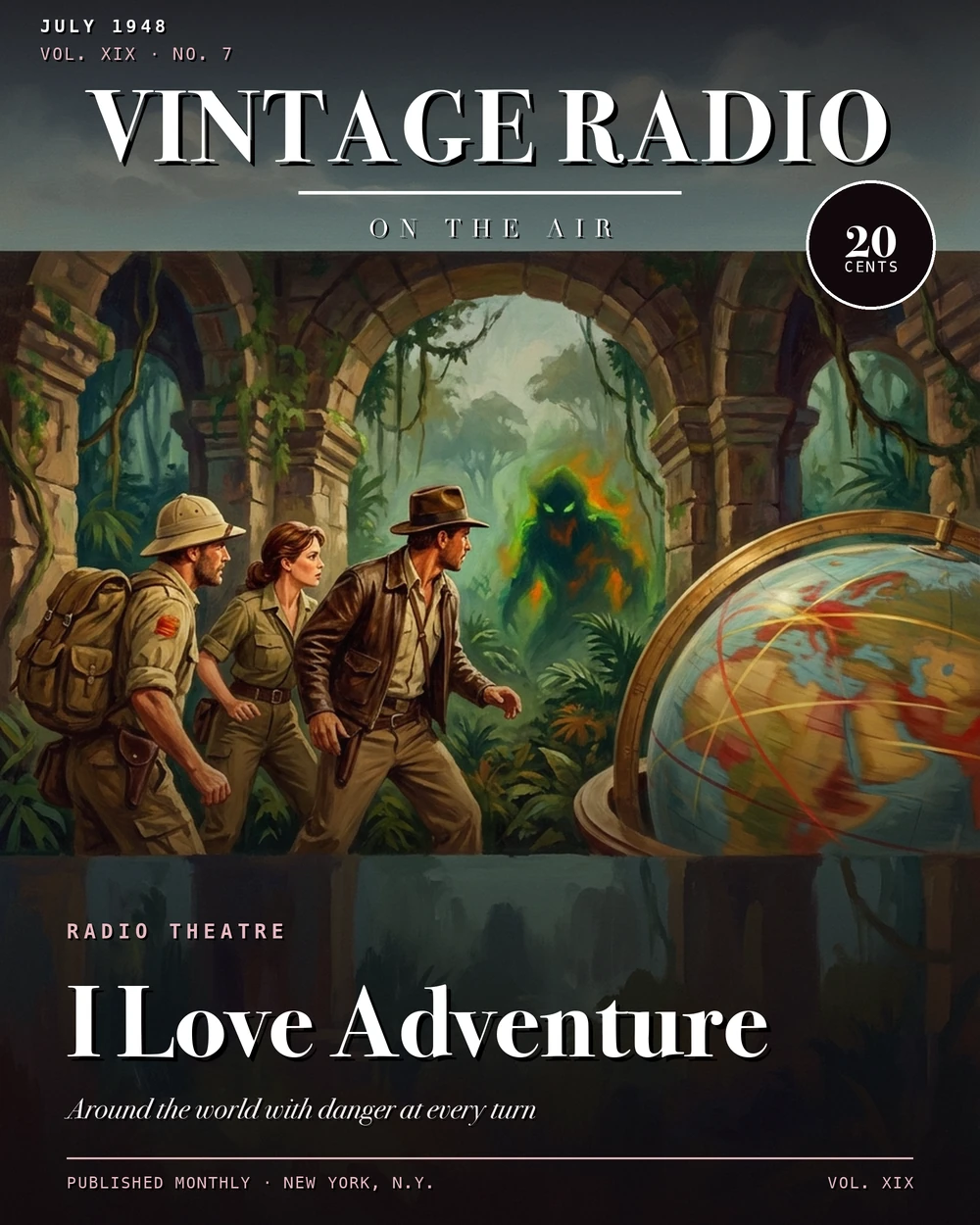
I Love Adventure
What It Was and Where It Fit
Carlton Morse's I Love a Mystery ran on NBC from 1939 onward and built one of radio's most loyal followings around three friends — Jack Packard, Doc Long, and Reggie Yorke — who ran the A-1 Detective Agency in Hollywood with the motto "No job too tough, no adventure too baffling." When that version ended and before the show's 1949 revival on Mutual, Morse tried to keep the characters alive in a new form. That effort was I Love Adventure, which broadcast on ABC from April 25 to July 18, 1948, on Sunday evenings at 7 PM. The result was a thirteen-episode run that served as a kind of transition vessel between the old West Coast I Love a Mystery and its coming East Coast revival — but it never quite found its footing.
The premise explained away the years since the three men last adventured together. During the war, Jack had gone into American intelligence, Doc had flown with the Flying Tigers in China before becoming a fighter pilot, and Reggie had returned to England to join the RAF. When the show opened, they had scattered and lost contact. The story picked up with Jack summoned to London to work for a mysterious extra-governmental organization called the Twenty-One Old Men of Ten Gramercy Park, dedicated to fighting the enemies of international peace. These unseen figures operated from behind a wall-sized two-way mirror in an enormous room — Jack could hear them but never see them. The setup had real atmosphere and, on paper, was an intriguing expansion of the franchise's scope.
A Show That Couldn't Make Up Its Mind
The trouble was that I Love Adventure never committed to any one direction. Jack's first assignment took him to Indo-China. In the second episode he was reunited with Reggie, and the two began reporting weekly to Ten Gramercy Park and taking on missions — rescuing a Burmese princess from a lost city, rescuing kidnapped schoolgirls in Italy, tangling with Nazi renegades and international terrorist gangs. The Twenty-One Old Men gave the show an almost Illuminati-like aura, an air of conspiratorial intrigue that could have anchored the whole run.
But in the seventh episode, the Old Men were abruptly dropped without explanation, and Jack and Reggie simply returned to running their detective agency in California. Then in episode nine, Reggie vanished from the series just as suddenly — no farewell, no explanation — and Doc Long turned up to take his place. Reggie had appeared in the first eight episodes; Doc stepped in for the remaining five. The cast didn't shuffle because of a creative decision the audience could follow; it shuffled because Morse apparently couldn't settle on what he wanted the show to be. The whole thirteen-episode run reads as a jerky mishmash, a fair characterization of a production that changed premises twice inside three months without ever landing on a stable identity. It lacked the dramatic tension and cohesion that both versions of I Love a Mystery managed in their better stretches.
Supporting the leads was a deep ensemble — Lillian Buyeff, Earl Lee, Harry Lang, Janet Logan, John McIntire, Jeanette Nolan, Rolfe Sedan, Luis Van Rooten, Betty Lou Gerson, Peggy Webber, and others. Jeanne Bates played Mary Kay Jones, described on the show as "the cutest secretary in Hollywood." Everett Glass voiced the spokesman for the Twenty-One Old Men. Dresser Dahlstead announced. Rex Koury played the theme on organ — the same Koury who had served the parent series.
The Sound of the Franchise
One element I Love Adventure carried over intact was its music. The theme was "Valse Triste," Op. 44, No. 1, by Finnish composer Jean Sibelius — originally written as incidental music for his brother-in-law Arvid Järnefelt's 1903 play Kuolema. The piece had been the signature of I Love a Mystery from its 1939 premiere, and its haunting quality, combined with the eerie chiming of a clock at the opening, had become one of radio's more immediately recognizable sonic signatures. Bringing both elements into I Love Adventure was a deliberate signal to the audience that this was the same fictional world, even in altered form.
Morse produced and directed the show himself and co-wrote it with John Paul Schofield. The scripts for I Love Adventure are preserved at both the Library of Congress — which holds the Carlton E. Morse Copyright Script Collection — and the UCSB Library, which holds the Carlton E. Morse Papers, fifteen linear feet of scripts, notes, outlines, and correspondence running from 1930 to 1987. The American Radio Archive, now also housed at UCSB, holds additional scripts from the show alongside material from I Love a Mystery, Adventures by Morse, and One Man's Family. The full run of recordings has survived on tape, though the source discs were often marred by scratch.
The People Behind the Characters
Michael Raffetto, who played Jack Packard, was born Elwyn Creighton Raffetto on December 31, 1899, in Placerville, California. He graduated cum laude from UC Berkeley's Boalt Hall School of Law in 1925, practiced law briefly in San Francisco, and then turned toward drama and radio. He had entered broadcasting by pitching a program to NBC San Francisco, then starred in, directed, and produced Arm of the Law for NBC Radio in 1930 and served as NBC's West Coast program director through 1933. His longest association was with Morse's One Man's Family, in which he originated the role of Paul Barbour at the show's premiere on April 29, 1932, and continued in that role until 1956. Raffetto suffered from tuberculosis throughout much of his professional life, leaving radio twice to recover; Morse would sometimes drive him from the hospital to the studio to act, and episodes were occasionally broadcast from his bedside. He died of throat cancer in 1990 at his Berkeley home.
Barton Yarborough, who played Doc Long, was born in Goldthwaite, Texas, in 1900, ran away as a youth drawn toward vaudeville, and eventually attended both the University of Nevada, Reno, and UC Berkeley, where he served as president of the University Dramatic Society. His NBC radio debut came in 1930 out of San Francisco. Like Raffetto, Yarborough had been with One Man's Family from near its beginning, playing Clifford Barbour in a run that would last nineteen years — ending only with his death. He was the only principal from the radio series to appear in all three Columbia Pictures features based on I Love a Mystery — the 1945 and 1946 films that gave the franchise its one major screen presence. For Doc Long, Yarborough adopted a Southern accent so thoroughly that he carried it into his later role as Sgt. Ben Romero on Dragnet; in private life he spoke without a trace of one. He died of a cerebral embolism in December 1951, just four days after filming the second episode of the Dragnet television series. His death was acknowledged in the radio episode "The Big Sorrow," broadcast December 27, 1951, with a dedication from Jack Webb.
Carlton Morse himself was born June 4, 1901, in Jennings, Louisiana. His family moved to Oregon in 1906 and later to a walnut ranch near Sacramento. He worked as a journalist across the Sacramento Union, the San Francisco Illustrated Daily Herald, the Seattle Times, the Vancouver Columbian, the Portland Oregonian, and the San Francisco Bulletin before bringing scripts to NBC and being hired at KGO, the San Francisco outlet of NBC's Blue Network. He joined the NBC production staff around 1929–1930. His two major creations, One Man's Family (1932) and I Love a Mystery (1939), were described by historian Gerald Nachman as "radio's preeminent serial" and "the most respected show of its type," respectively. Radio historian Jim Harmon, writing in his 1966 book The Great Radio Heroes, called I Love a Mystery "the greatest radio program of all time." Morse held a star in the Radio section of the Hollywood Walk of Fame at 6445 Hollywood Boulevard. He died May 24, 1993, in Sacramento, at ninety-one.
After the Bridge
I Love Adventure ended in July 1948. About a year later, the Mutual Broadcasting System launched a new version of I Love a Mystery on October 3, 1949, which ran until December 26, 1952. That revival used Russell Thorson as Jack Packard — Thorson had appeared in a supporting role on I Love Adventure before departing for the East — along with Jim Boles as Doc Long and a young Tony Randall as Reggie Yorke. It relocated to New York, shifted to fifteen-minute weeknight episodes, and recreated Morse's original NBC scripts rather than breaking new ground. The I Love a Mystery franchise also fed into the early concept work on Scooby-Doo at Hanna-Barbera, where the property carried the working titles "Mysteries Five" and "Who's Scared?" before reaching its final form. A television movie pilot was produced in 1967 for Universal Pictures — starring Les Crane, David Hartman, and Hagan Beggs — but was shelved for six years before NBC broadcast it in 1973.
Martin Grams Jr.'s The I Love a Mystery Companion, a 400-page reference work, documents I Love Adventure alongside the full franchise, providing plot summaries, episode numbers, broadcast dates, cast lists, and excerpts from Morse's own correspondence. The fact that fewer than 200 recordings survive from across the franchise's 1,695 total broadcasts makes the complete preservation of I Love Adventure's thirteen episodes — scratches and all — a meaningful piece of the record. The show matters less as a successful series than as evidence of what happened when a creator of Morse's caliber tried to hold something together between two stronger iterations of the same idea, and found, week by week, that he didn't quite know how.